

The Call of Mammitum: An Origin Story.
Where did this comes from?

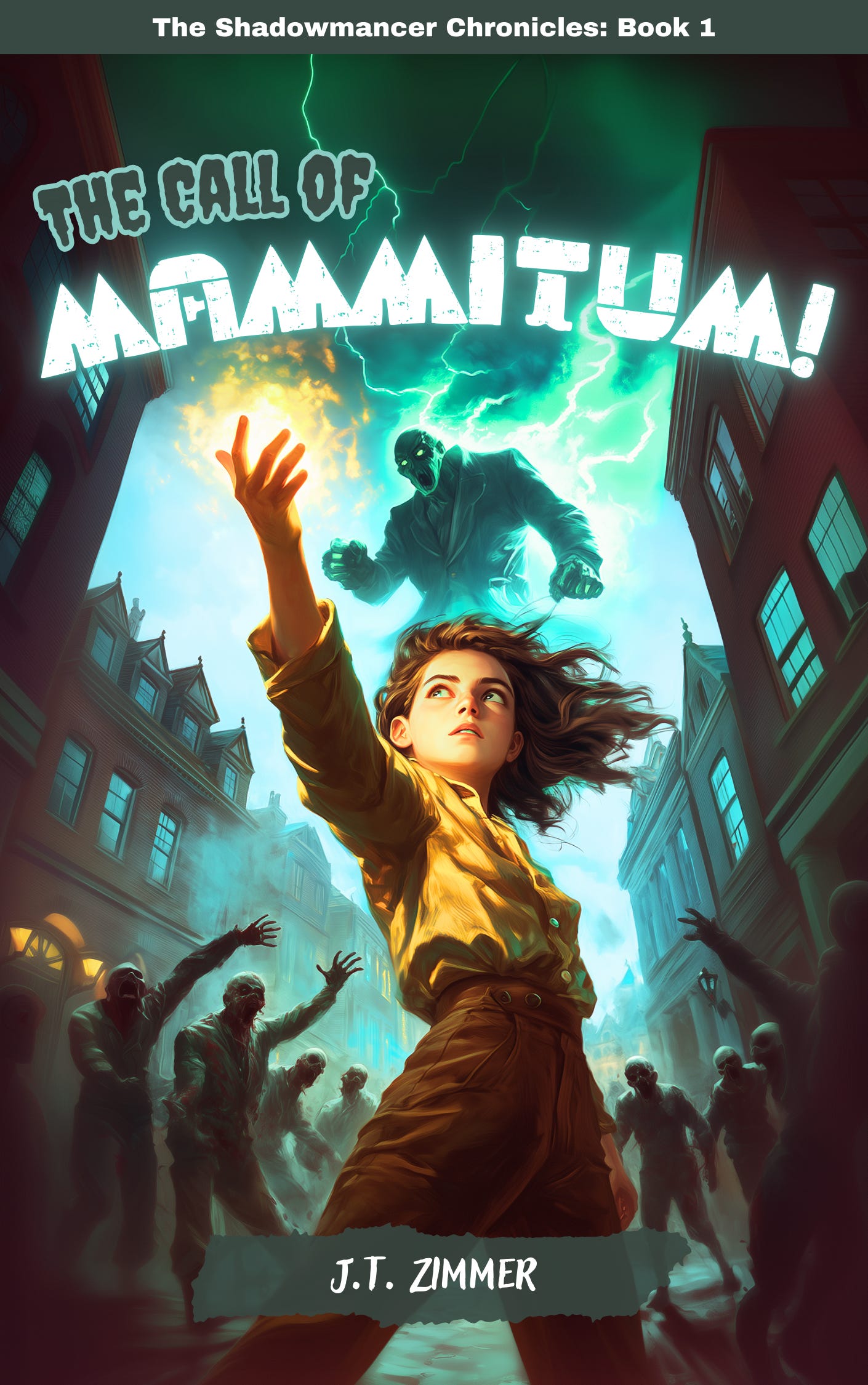
The Call of Mammitum is, to date, the defining work of what I hope to be a satisfying career as an author—even if not a lucrative one. I have written a few novels in my life, one I tried to publish but neither I nor the book were ready. I never intended this book to take hold of me as it did—in fact, I never intended to put my name on it at all. See, I wanted a portfolio project—a throwaway series to publish via KDP as a prop for my ghostwriting services.
Origins
It was supposed to be a cute book about a teen girl fighting zombies with magic, and then other creatures across six books. It started as a Kindle category grab: using PublisherRocket, I discovered that zombies were a hot seller—thanks to The Last of Us on HBO Max. The name Mattie Mae stuck in my head, and of course I needed zombies, and a cemetery, and I wanted a Lovecraftian feel to the thing so I set it early in the 20th century in New England, Massachusetts to be exact. I had no lore, no mythos, nothing but Mattie Mae, a bad day at school, and whispers in the cemetery that led her to a mysterious ancient tomb. Throw in a boy in a wheelchair, a redhead and a blonde foil and viola! Instant mid-grade monster book.
At first I named it The Undead of Eastmere because that was the cockamamie fictional town name I came up with. Then the story revolved around mysterious runestones with mysterious symbols and mysterious elder gods, and it became The Runestone of Ma-We-Tum (an unfortunate mis-transliteration of Ma-Mi-Tum I got from somewhere when trying to find cool ancient underworld god names). But in September of 2024, after hashing out sketches and outlines and organizing the story according to the Story Grid Narrative Path, I settled on The Call of MA-MI-TUM. That was draft 1, and the story “worked” in the sense that it was coherent. My former Story Grid mentor, Leslie Watts, was kind enough to give that hideous thing a read and encouraged me to keep the bones but work on the choreography and story values. So draft 2 became about fixing the magic and crafting the lore. That sent me into some deep rabbit holes.
The Lore
Though I’d somehow struck the right goddess, I didn’t know anything about her that a cursory Wikipedia search wouldn’t bring up. I had to choose whether to use legitimate mythology or craft some Lovecraftian bullshit. I happen to have, as you do, a copy of the Simon Necronomicon which is full of hacked together Mesopotamian mythology with neat sigils. But it’s bullshit. And when I went looking for the myths behind the names, I realized the story I was telling was much bigger and deeper than what I originally laid down. I wanted to write this series as a creep up Maslow’s hierarchy, starting with death and zombies, but I realized, this wasn’t a story about death as much as about the dead, and the grief left behind. Something Mattie and I have in common.
In my Sumerian studies, I realized Mammitum (MA-MI—TUM) was a much more important goddess than simply the latter wife of Nergal: she was the creatrix, she who creates fate, so called Ninhursag, so called Nintu, so called Mami. But she wasn’t the most important goddess for my story. Thanks to Stephanie Dalley’s and Diane Wolkstein’s masterful compositions (many based on translations by and in collaboration with Samuel Noah Kramer), I discovered that Inanna/Ishtar was really my model for Mattie’s transformation, not as an ascent up a pyramid, but as a descent to integration. And my cute 6 book series became 7 in alignment with the seven gates of the underworld.
I brushed up on Murdock’s The Heroine’s Journey and collided with an idea that was banging around in my head about the specificity of the seven adornments which are removed from Innana/Istar on her descent, and this led me to Sylvia Perera’s The Descent to the Goddess. I realized that the position of the articles on Ishtar’s body aligned strongly with the positions of the seven chakra. I studied these correlations intensely, trying to find other corollaries, sacred heptads, seven sins, seven virtues, seven angels, seven geniuses.
The Rosette
In my first draft I had a generic symbol that wasn’t clarified and I needed it to mean something. I tried a seven feathered peacock after Tawûsê Melek, the peacock angel in Yazidism. Angels in many traditions, like the gods of old, had some specialization but nothing that fit. Even Mesopotamian gods were somewhat specialized but also too ambigious, so I looked at the Me (like May), which were celebrated laws of civilization handed down by the gods, specifically taken by Inanna from Enki and delivered to the people. But there were about a hundred, of those maybe 80 translated. So much of that culture is still poorly understood, with thousands of tablets untranslated. So I got creative.
My symbol became a rosette, as that was often worn by the gods, and associated with Inanna in many reliefs. With seven petals, I used the starflower as the botanical model and put the Dingir symbol at its center to represent the Me-Nam-Dingir—the way of godship.

Seven petals, split in twain to represent the seven me-ma’kh-dub or tablets containing the fourteen high Me: one light and one dark power per tablet. Through the perfect execution of the Me (me-shu-du) a seeker may achieve godship as Ut-napishtim attained and Gilgamesh sought (and eventually got).
But the Dingir doesn’t only mean “god”, it literally means “to decide” or “one who decides”. Four crossed lines, four paths meeting in a crisis.
And there I had my lore, and I was ready for draft 2.
But weaving in the lore wasn’t even the biggest part of draft 2—there I was just filling in grey areas. It wasn’t clear how my main characters attained their “talents”. There was some insinuation at family legacy, but I quickly scrubbed that, and I didn’t want a “chosen one” trope either. So it became a call, and an answer—and a choosing. The relationships between the four kids became the center of the story. Nothing structurally changed there from draft 1, but the heart of the interactions got special attention, and became songs as I began forcing the emotional values through lyrical expression. Almost every scene of value in this book got a song: the story inspired the songs, inspired the story, reflexively. I rendered them with AI through Suno.com for my own pleasure but share them here because some of them turned out really good. I’d love a human band to pick them up someday, but for now they’re just extra material.
Mattie’s Voice
Draft 3 was where I found Mattie’s voice. Draft two was written by Justin Zimmer, a balding 45-year old man that likes writing science fiction, and that just didn’t work. Word choices were sometimes too technical, too fun or cheeky, too me and I could NOT be the one telling this story. So, I rewrote the first five chapters—representing Monday—numerous times as a set to find the style and voice I was looking for. See, there are some concepts in Story Grid I was grappling with at the time: the Author, and the Specific Audience Member (SAM). The Author is the voice telling the story, the narrator, and I started by writing in a floral and lyrical style as if an elder Mattie was looking back on her life in past tense. I even structured the prose in a mythical style with line breaks and hanging indents and, oof. That all pushed the narrative distance a bit too far from where I wanted it.
I misinterpreted a comment by my mentor at the time that something was in the way of SAM and I took that to mean I needed to write in present tense and in the voice of fifteen-year-old Mattie to narrow the distance. So I did. I rewrote the entire book in first person, present tense using strict style sheets to hone word choices and mannerisms. That wasn’t what she meant though because I kept the mytho-lyrical formatting and Draft 3 was a disaster. A lot of my early readers couldn’t get past it, and the way the broken paragraphs and stuttered lines read totally borked the information architecture of the piece, leaving it illegible. Oops.
So I rewrote draft 3, keeping the voice but fixing the formatting and the sentence breaks along with another rewrite of the first couple chapters to make the supernatural elements more clear on page 1. I’m still not happy with those early chapters, and if you are reading a published or draft 5 version of the book, I really hope I did better this time.